
System/Next 26.11
This page (https://www.specnext.com/latestdistro/) is where the latest distribution is always found. Distributions are now named by the year and month of their release (eg 24.11 was released in November 2024).
If you would like access to new "bleeding-edge" features not yet released as part of the official distribution, please visit our gitlab repository here: https://gitlab.com/thesmog358/tbblue. This also includes tracking of any known current issues.
TL&DR for KS3 users
Instructions have to cover ALL Next models and all eventualities so they may seem too complicated. They are not.
KS3 instructions are pretty straightforward. Download 3 files onto a NEW card (DSU, install.bas and updater.bas - links below). Put it in the Next, turn it on, select "Browser" press D (changes drive), then select install.bas, press ENTER, press Y wait, press C wait and the software update is done.
Reboot pressing U, answer Y and then wait until flashing is done. The core is updated. Machine resets to the Testcard screen. Done!
TL&DR for KS2 users
Instructions have to cover ALL Next models and all eventualities so they may seem too complicated. They are not.
KS2 instructions are even easier. Download 1 file onto your boot card (DSU - link below). Put it in the Next, turn it on, select "Tools" then "Updater" press ENTER, press C wait and the software update is done.
Reboot pressing U, answer Y and then wait until flashing is done. The core is updated. Machine resets to the Testcard screen. Done!
Table of contents
- What's new
- Distribution downloads
- How to update
- Note for PS/2 keyboard users
- Troubleshooting tips
- Credits
What's new
System/Next 26.11 contains the following enhancements:
- NextZXOS v2.10
- .ZED dot command to edit textfiles in NextBASIC programs
- Core version: 3.03.00 (Issues 2,4,5) featuring Zero Wait State 28MHz and zxnDimensionalDMA (zxnDDMA aka Blitter)
- New FIRMWARE 1.46
- Updated official additional cores for Issues 2, 4 and 5: Sinclair QL with many enhancements such as Fat32 drivers (so it plays nice with the Next core)
- Additional Personalities: ZX Spectrum Arabic (3 rom versions), ZX Spectrum +2 French and Spanish versions, ZX Spectrum Swedish Version, ZX Spectrum +2A/+3 v.4 English and Spanish editions, ZX Spectrum +2B/+3B v.4.1 English and Spanish Editions, Microdigital TK90X v.1, Microdigital TK90X v.2 in Portuguese and Spanish editions as well as Microdigital TK95 in Portuguese and Spanish Editions
- Support for 60HZ mode per personality (especially Microdigital models start by default in 60Hz mode) in every mode including RGB
- New INFO screen during boot giving you info about your card readers/sd cards (incl. partition types), ESP, RTC and RPi0 as well as core version and NextZXOS version.
- Did we mention Blitter? 🤣
- Updated .guide dot command that supports larger files and two fonts!
- Support for AlpineNext the new distribution for the Pi0 and Pi0 W accelerators with SPI mode (plus pause/play/rewind on TZX!)
As always, full details can be found in the docs directory of the distribution (for reading on a PC or Mac). Additionally, guides detailing many of the NextZXOS features can now be accessed directly from the menu system.
Distribution downloads
NOTES
- This version brings back the differential update system, so you can use the Update menu once again.
- A brand new SDHC Card is recommended at a minimum
Full distribution downloads
These downloads contain all files in the distribution, suitable for writing to a newly-formatted SD card, or an old card that has not been recently updated.
- For Issue 5 (KS3) users: install.bas - Updates your "updater.bas" for your internal card
- For Issue 5 (KS3) users: updater.bas - Updated version which allows updates for both your internal And external card
- Complete System/Next distribution: sn-complete-26.11.zip
- System/Next distribution, without source code: sn-nosrc-26.11.zip
- System/Next distribution, lightweight version: sn-lite-26.11.zip
- System/Next distribution, differential update: sn-update-26.11.dsu(recommended)
Other downloads
- AlpineNext distribution for Pi0 accelerators: alpinenext-0.5.3-20260525-z2w.img.xz (NOTES: this is a BRAND NEW download and it is a must update for people with Issue 2 and Issue 4 machines and for users that are just getting a Pi0 or require to rebuild their cards - You will need a 16Gb microSD card)
- System/Next distribution, image for emulators (1Gb image): sn-emulator-26.11.zip
How to Update
Before you update and PARTICULARLY if you have an Issue 2 (KS1) machine watch this video! It may save you some frustration later
A. Prepare the files
If you have a KS3 (Issue 5)
Please download the DSU file, install.bas and updater.bas from the links above on your PC or MAC or Linux machine. Get a fresh FAT32 formatted SD Card and copy the files into the root folder of the card. Note that Ideally this card should NOT be a System/Next card. If it is you'll have to do one more step.
If you have a KS2 (Issue 4)
Download the full distribution OR the DSU file from the links above into your PC or MAC or Linux machine.
If you have a KS1 (Issue 2) only - Obligatory - DO NOT SKIP THIS STEP!!!!
FIRST You should download the following two files from the gitlab repo: TBBLUE.TBU and TBBLUE.FW into your PC, MAC or Linux machine and then the DSU file from the links above
You will HAVE to perform the core update first as from core 3.03.00 on the KS1 cores have been split in two; an HDMI part and a VGA part. If you haven't watched the nice video above you SHOULD go back to it now to see how you should do it, what to expect and WHY you definitely should do it!
NOTE: Due to configuration file change your monitor settings will be changed to the "Test Card Mode" (timing=8 in config.ini). This means that if you do not perform the core update first from the distribution update on a KS1, the FW will attempt to find the special test card core (which allows output from both VGA and HDMI in order to setup your display), it will NOT find it there and it will make the system appear bricked. It is not (plus you cannot brick the machine because you always have the AB core to get back to) but you'll save yourself time of needless frustration you can avoid if you perform the steps the way we lay them out and in this order!
B. Updating the software and core
Before you begin - Check you performed the steps above according to which machine you have (Note: N-Go and X-Berry Pi clones are classified as KS1 machines).
Step 1
Before plugging in your Next, get the Next SD Card (see the image below for how the Next Distribution SD card should look like) and insert it to your PC (or Mac, or Linux). You will need an SD card reader; many laptops/notebooks have one built-in.

Step 2
Navigate to the place you downloaded the distribution and double-click it to unzip. You do not need to unzip ANYTHING if you just downloaded the DSU update file
Step 3
For KS1 machines
Copy the TBBLUE.FW, TBBLUE.TBU and sn-update-26.11.dsu files onto the root of your card. DO NOT USE A COMPLETE DISTRIBUTION; IT WILL COMPLICATE THE UPDATE PROCESS!
For KS2 machines (and KS3 machines with removed internal card)
Copy sn-update-26.11.dsu files onto the root of your card or copy all the unzipped distribution files onto the root of your SD card and allow them to overwrite its contents
For KS3 machines
Copy the install.bas, updater.bas and sn-update-26.11.dsu files onto the root of a fresh card which should NOT have a TBBLUE.FW file on its root
Step 4
Using your PC or Mac’s EJECT option, make sure you EJECT the card before removing it from the reader.
Step 5
Insert the card in your Next. If you have copied the entire distribution onto the card, you can wait until the TestCard appears like the picture below but it’s recommended that you force the selection of display after you power up by pressing D for Digital (if you have a DVI or HDMI display), V for VGA or R for RGB (RGB requires an aftermarket SCART Cable)If you have a KS1 which outputs on HDMI by default, then you will not see this display but the new boot screen! If you have a machine that you just downloaded the DSU file to you will still see the old boot screen and you will update the core immediately after the distribution update, so refer to Step 7 and return to Step 6 after the distro update has completed
Step 6
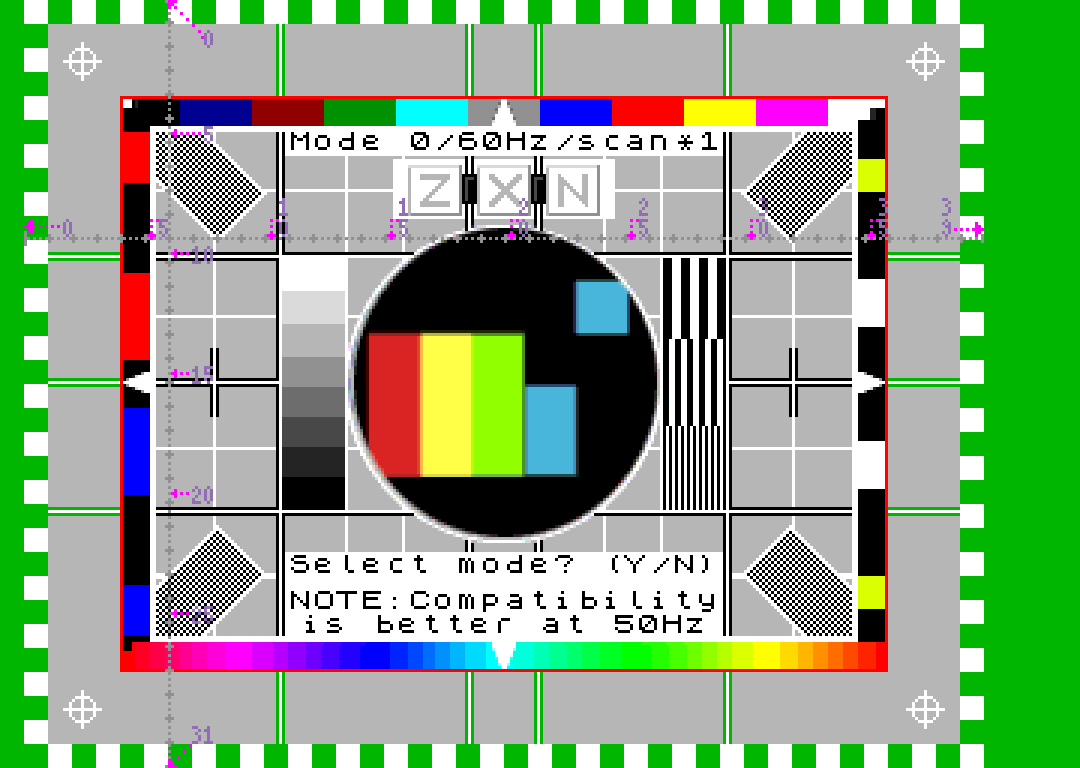
If you picked the proper display above by pressing ENTER and Y and then have pressed U as instructed or IF your core is too old, your screen will change to the following:

The following images show what happens in order according to the machine you have during the core update process:
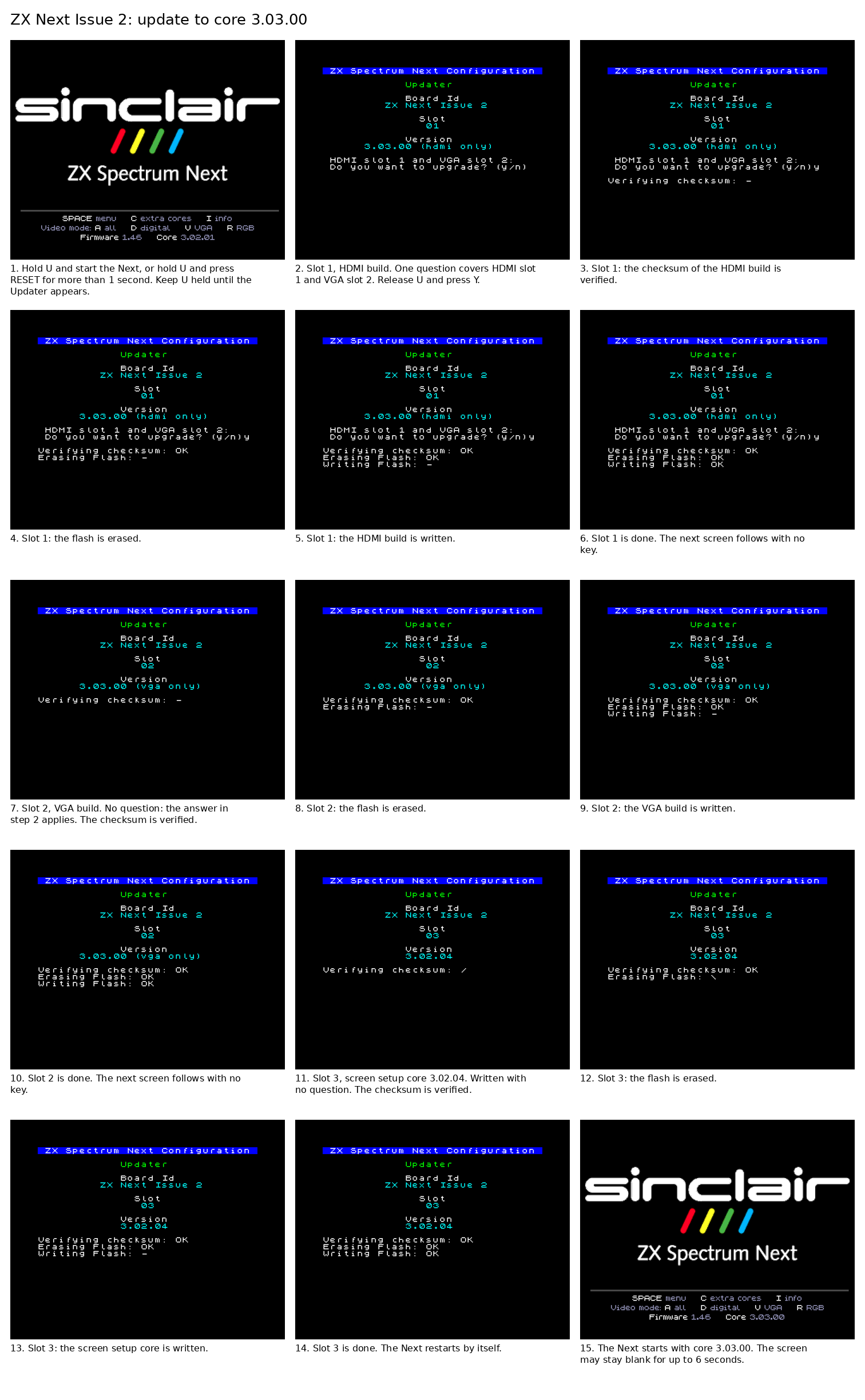
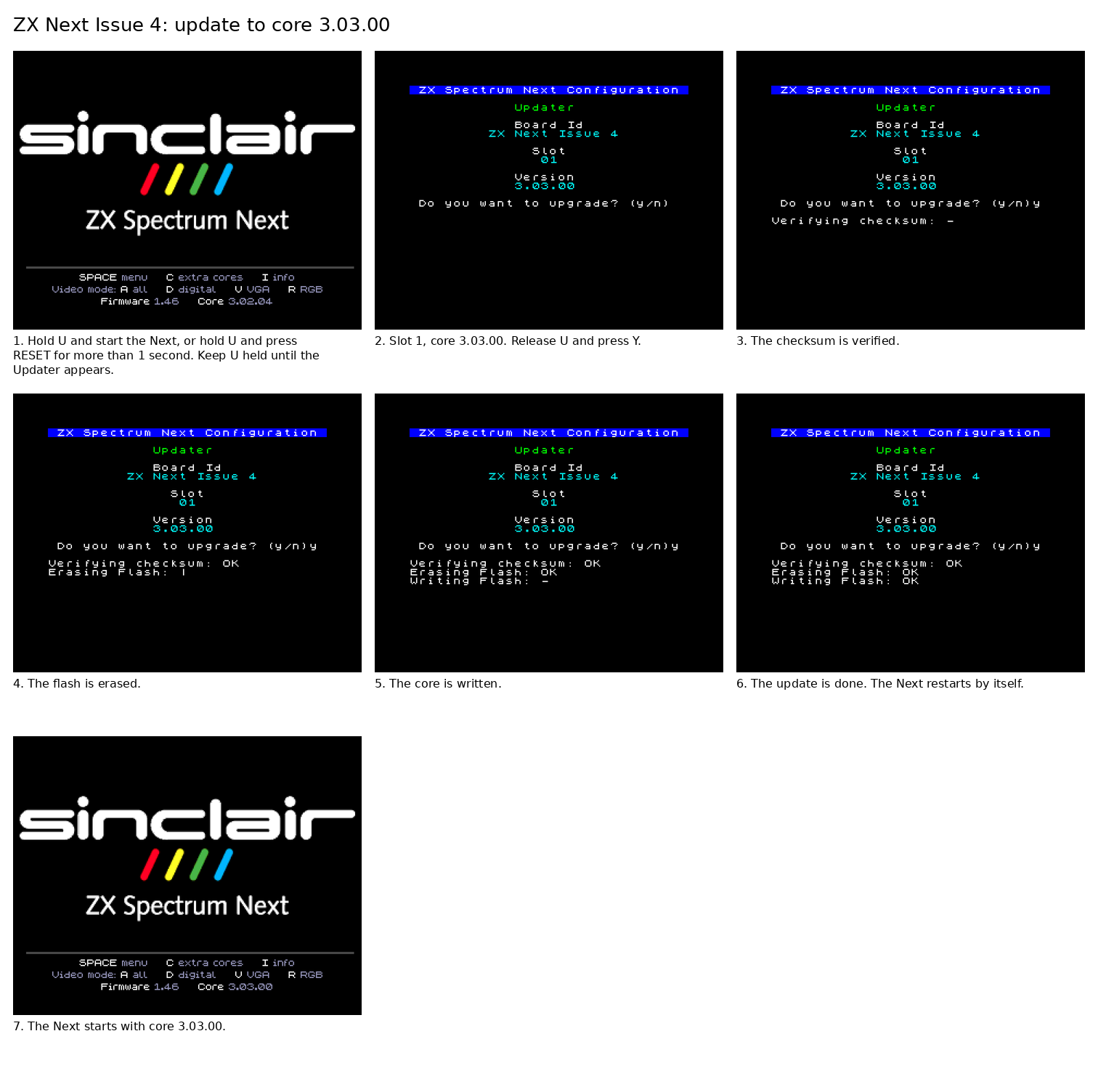

Step 7
If you finished the core update in the previous step, or if you have a KS2 or KS3 machine, now is the time to update the distribution itself. That is the Operating System, drivers, documentation etc. The process using the previously downloaded DSU file is very easy; basically a single step process. In the case of the KS3 machines
For Issue 5 machines only you will have to do a small step to upgrade the program that itself upgrades the distribution. This is only done once and allows machines with dual drives to update any card from any source! From the NextZXOS Menu, Launch the browser, press D and then select install.bas and press ENTER. Answer Y to the first prompt (If you want; we won't force you) and then when the Updater launches select C. That's it!
If you have any other machine (with a single SD Reader) you can launch the update by either using the NextZXOS Menu Option Updater (found under "Tools") or by using the browser and launching the DSU file directly! (See images below for both cases below)


Once the update finishes you should long-reset your machine (or power on-off) and the testcard will appear; select your desired video mode and the machine will boot into it so you can either start using your Next (if you performed the Core upgrade in the previous step), or you can press U and do the core upgrade right now! (See Step 6 above).
Note for PS/2 keyboard users
If you are a board-only Next owner and only use a PS/2 keyboard, you may find that the keyboard doesn't work after booting into NextZXOS (or one of the other Spectrum personalities). This is because the distribution assumes only a mouse will be plugged into the PS/2 port. To fix this, allowing a keyboard instead (or a splitter with both keyboard and mouse), follow these steps:
- Power-off the Next completely.
- Power on again, and press SPACE when the firmware selection screen (with the Sinclair Spectrum Next logo) appears.
- Press SPACE again to enter the firmware options editor.
- Press SPACE with the flashing highlight on the PS/2 option, to change it from "Mouse" to "Keyb.".
- Press ENTER to save the change.
- Press ENTER to start the currently-selected personality.
NOTE: If you have a joystick or controller with at least 2 different fire buttons, you can use the main fire button (or controller button B) instead of SPACE, and the secondary fire button (or controller button C) instead of ENTER.
Troubleshooting tips
- Users of FlashAir cards are advised to perform ALL file copy operations locally on their PC/MAC and NOT over the air.
- If your current core is older than v1.10.10 you may experience issues with your keyboard and/or display. Please follow the expanded instructions in the previous versions of the TBBLUE distributions and the Quick Start guide here to flash your core.
- At the testcard screen, you are strongly advised to experiment with different settings to achieve the best results for your display. For optimum results, use a VGA cable and ensure you select a VGA mode (0 to 6) and 50Hz frequency; this will ensure the Next display is perfectly timing-accurate. Selecting HDMI timing (mode 7) or 60Hz frequency may cause inaccurate displays with some standard Spectrum software (particular demos/games with special multi-colour effects).
Credits
Core 2010-2018: Victor Trucco
Core 2019-2026: Allen Albright
Contributors: Charlie Ingley, Jim Bagley, Fabio Belavenuto
, Garry Lancaster, Mark Smith, David Banks, David Saphier, Phoebus R Dokos
QL Core 2015-2019: Victor Trucco, Till Harbaum
QL Core 2024-2026 : Theodoulos Liontakis (LionT)
QL and Next hardware adaptations: Theodoulos Liontakis.
NextPi, NextPi/2: D. Rimron-Soutter
AlpineNext: Michael "Flash" Ware, Phoebus R Dokos, SpecNext Ltd and the Alpine Linux team
Next CP/M BIOS: Garry Lancaster
Dreamworld Pogie: Lyndon J Sharp/Phoebus Dokos (WASP – http://www.wearespectrumprogrammers.com/) / Distributed under License
Orb Run: Matt Davies (https://github.com/next-dev/nx)/ Distributed under License
Spectron 2084: Robin Verhagen-Guest / Distributed under License
Nxtel2: Robin Verhagen-Guest / Distributed under License
NextDAW/NextDAW PRO: Gari Biasillo (http://nextdaw.biasillo.com)
Warhawk: Michael Ware, Jim Bagley, Lobo Trans, Space Fractal / Distributed under License
Nextoid!: Lampros Potamianos (WASP – http://www.wearespectrumprogrammers.com/) / Distributed under License
Angry Bloaters!: Lampros Potamianos (WASP – http://www.wearespectrumprogrammers.com/) / Distributed under License
3D Monster Maze, 3D Defender, Trashman by Malcolm Evans - Fusion Retro Books - Distributed under License
Hibernated1: Stefan Vogt (http://8-bit.info/) / Distributed under License
cave81: Marco Varesio / Distributed under License
Knight Night: David Saphier / Distributed under License
Halls of The Things: Simon Brattel / Distributed under License
ZX80 Shop Steward: Simon N Goodwin / Distributed under License (http://simon.mooli.org.uk)
baSnake: Marco Varesio / Distributed under License
Santa’s Chimney Challenge: Paradise Games / Distributed under License
Mouse driver: Tim Gilberts and Chris Cowley
UART driver: Tim Gilberts
RTC driver: Tim Gilberts
PAW (Disk version): Tim Gilberts / Distributed under License
ZEUS Assembler: Neil Mottershead and Simon Brattel (modified by Jim Bagley) / Distributed under License
SPED: César Hernández Bañó (with Tim Gilberts) / Distributed under License
Nextramon: Simon N Goodwin / Distributed under License (http://simon.mooli.org.uk)
NextBASIC Profiler: Simon N Goodwin / Distributed under License (http://simon.mooli.org.uk)
PS/2 keymap: Phoebus Dokos (WASP – http://www.wearespectrumprogrammers.com/)
NextZXOS: Garry Lancaster (http://www.worldofspectrum.net/zxplus3e/)
NextZXOS keyboard map screens: Richard Hallas
Looking Glass: Geoff Wearmouth (https://twitter.com/warmtoffee)
ZX80/81 Emulators: Paul Farrow (http://www.fruitcake.plus.com)
NextGuide: Matt Davies
MenuEdit: David Saphier
ZXDB-dl: David Saphier, D. Rimron-Soutter, Remy Sharp
Demos: David Saphier (http://zxbasic.uk/), Geoff Wearmouth, Michael Ware, Gari Biasillo, Robin Verhagen-Guest, D. Rimron-Soutter, Mike Dailly (http://www.cspect.org)
Utilities: Jim Bagley, Geoff Wearmouth, John M Kerr,(http://mycodehere.blogspot.com), Kev Brady, César Hernández Bañó, D. Rimron-Soutter, David Saphier, Simon Brattel, Robin Verhagen-Guest, Simon N. Goodwin, Rusty Pixels, Peter Ped Helcmanovsky, Matt Davies
BBC BASIC for Spectrum Next: Core BASIC interpreter by R.T.Russell with Spectrum Next implementation by Dean Belfield, Distributed under License
Dot Commands: Allen Albright, Jim Bagley, Gari Biasillo, Matt Davies, Johan Engdahl, Tim Gilberts, Garry Lancaster, Peter Ped Helcmanovsky, D. Rimron-Soutter, David Saphier, Einar Saukas, Remy Sharp, Victor Trucco, Marco Varesio, Robin Verhagen-Guest, Chris Taylor, Janko Stamenović
QL (non exhaustive) Software and Hardware credits
Speedscreen written by Simon N Goodwin
QDOS Classic by Mark Swift with Simon N Goodwin and portions by Phoebus R Dokos
FAT32 driver by SpecNext Ltd / Phoebus R Dokos based on work by chanN, Peter Graf, Theodoulos Liontakis, Simon N Goodwin, Dilwyn Jones, Mark Swift, Richard Zidlicky, Jonathan Hudson, Laurence Reeve, Daniele Terdina, Davide Santacchiara, Marco Ternelli, Marcel Kilgus, Wolfgang Lenerz, Tobia Froeschle (and others)
Portions Hardware and Software copyrights: Peter Graf, Tobias Gubener, Davor Jadrijevic, Marcel Kilgus, Wolfgang Lenerz, Theodoulos Liontakis, Alexey Spirkov. All other copyrights are of their respective owners; check the core's source for an exhaustive list